
If you have visited our site, you have probably already wondered who your ancestors are and what is the history of your family? Perhaps your family traditions tell of the noble or aristocratic origin of the family, or maybe you even bear a noble surname. There is actually nothing unusual in this, because even today there are many descendants of the nobility living among Ukrainians. Many of them, unfortunately, do not suspect, or know little about their noble origin.
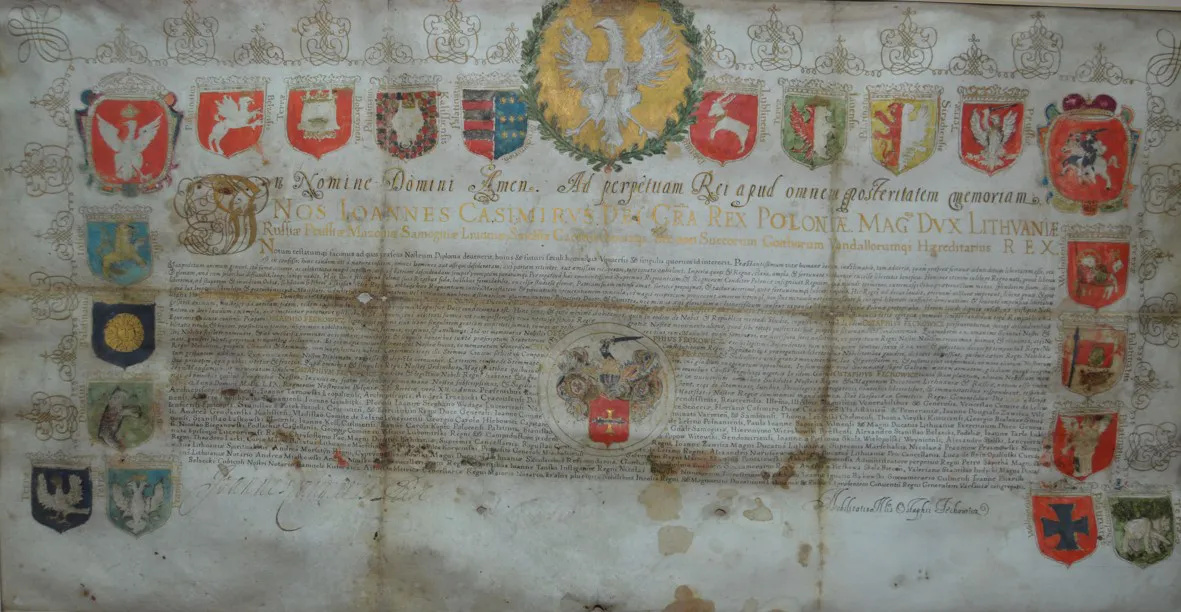
Ennoblement privilege granted in 1659 to Cossack colonel Yatsk Fedkovych. Lviv Historical Museum
The nobility is a privileged class of Poland and later of the Polish-Lithuanian Commonwealth. As a separate social class, the nobility began to form from the middle of the 14th century, when the Ukrainian lands were divided between Poland and the Grand Duchy of Lithuania. To become a nobleman, one had to distinguish oneself on the battlefield, serve the monarch faithfully, for which it was possible to obtain ennoblement, that is, to receive noble rights and privileges, a family coat of arms. One of the defining features of the nobility was the right to own land. After all, a true nobleman had to be a landowner. To emphasize their proprietary position, the nobility began to take their surname after the name of the center of their possessions. Hence, Potocki - owners of Potock, Ostrohski - heirs of Ostroh, Terletski - nobility from Terl, or Kulczycki - from Kulczycki. If your surname ends with the suffixes -sky, -ska, then this is one of the possible signs of your noble origin.
Despite the popular and often declared ideal of nobility equality and brotherhood in the Polish-Lithuanian Commonwealth, this estate was far from homogeneous and was quite strongly stratified only by property criteria. At the top pole of power and property power was the nobility, usually of Polish origin, which owned entire volosts and keys to settlements, numbering dozens of villages, private towns and fortified castles. Representatives of powerful families from generation to generation were represented in the highest government posts of the state, were part of the entourage of kings. Such nobles from the territories of Western Ukrainian lands included the Tarnowskis, Kmyts, Gerburts, Kamianets, Mnishkis and others. A feature of the Ukrainian lands within the Grand Duchy of Lithuania (Kyiv region, Volhynia, Podillia) was that the highest stratum of society here were the princes. Several dozen families of princely origin, despite their property status, enjoyed special respect and treatment in society, and the princely power acquired a rather sacral significance, rising above the gentry of the state as a whole. The more prominent princely families included the Ostroz, Vyshnevetsky, Zbaraz, Zaslavsky, Chortoryysky, Chetvertynsky, and others.
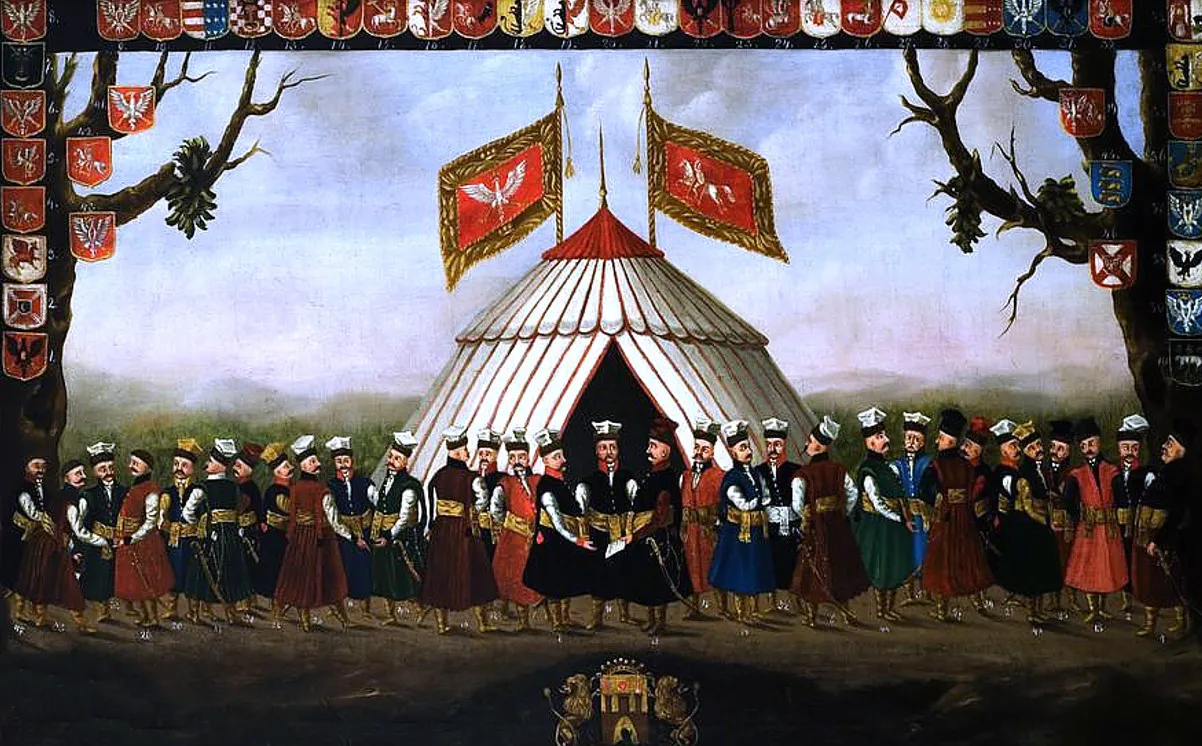
Allegorical depiction of the Polish-Lithuanian Commonwealth. The people in the painting are noble citizens who had full rights in the Polish-Lithuanian Commonwealth. Around the painting is a frame in the form of the coats of arms of the lands that were part of the state. Artist unknown. 18th century.
The numerical stratum was the middle nobility, which owned from several to a dozen villages, actively participated in the political life of the region and the state, and was represented in government posts of local importance. Over time, the nobility of Ukrainian origin gradually adopted the more prestigious life of the Polish nobleman, converted to the Catholic faith - after all, this in the long run contributed to advancement in the social hierarchy, allowed for a more advantageous marriage and contributed to further integration into the noble community of the Polish Crown. However, despite the use of the Polish language and the Catholic religion, the nobility of the Ukrainian lands had a sense of their own separateness, and the local nobility proudly called themselves Ukrainian knights. The famous Renaissance publicist from the Przemysl Land, Stanisław Orikhovsky, being a Catholic, speaking in Polish outlined his identity with the formula of double self-identification "Gente Ruthenus natione Polonus" (by origin Ruthenian, by citizenship (nationality) - Pole). A representative of the noble family of German origin, the Herburts, who in the second half of the 14th century settled in Galicia, Jan Szczesny Herburt already at the end of the 16th century identified himself as a "Ruthenian", spoke in defense of Orthodoxy, built churches, and composed songs in the Ukrainian language.
At the opposite pole of the gentry community was the petty gentry, who owned one or two villages. Often dozens of families from one gentry family owned small shares of the estate in one village. Many such families preserved their Orthodox faith and Ukrainian identity. Due to the large population of these families, their descendants are still alive today - these are the numerous Yavorsky, Kulchytsky, Terletsky, Sozansky, Dobryansky and others. Many petty gentry lived in the Ovruch region - for example, the countless Vyhovsky or Melenevsky families. Many of these families were not rich, and over time they could even become so marginalized that their life was no longer much different from the situation of a free peasant. Only gentry pride, privileges and pride in their origin elevated them above the general population of commoners. Their low-income status saved these nobles from the fire of class revolution, the struggle against the bourgeoisie and exploiting classes, which was declared and waged by the Bolsheviks in Ukraine after 1917 (in Western Ukraine after 1939). Many other noble families were deported to Siberia by the Bolsheviks, or were physically destroyed altogether. The more successful ones managed to emigrate to the West.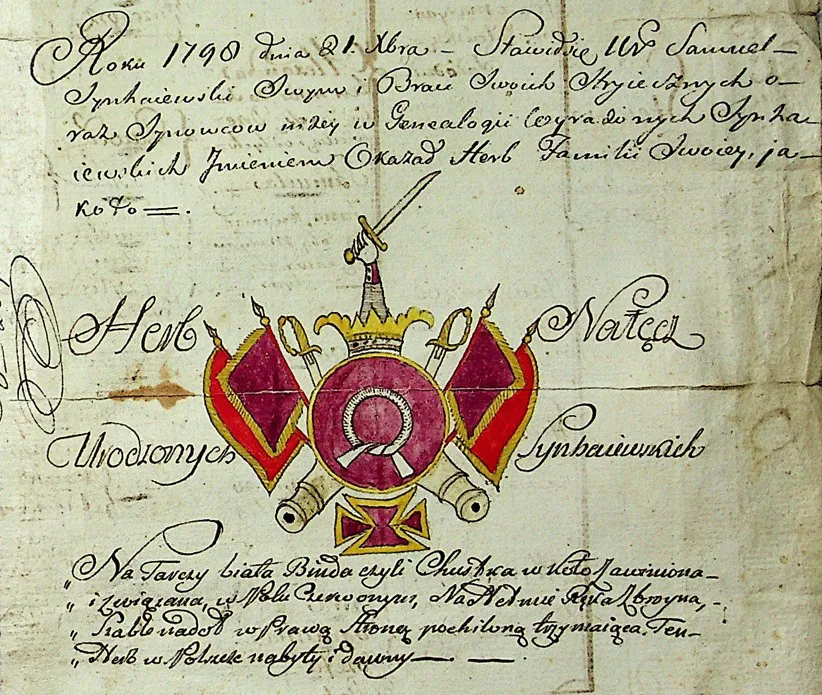
Noble coat of arms of Naleńch in the case of confirmation of the nobility of the Singajewski family
The price for the lives of those who survived in the Soviet realities was the concealment, silence, and ultimately forgetting of the origin of their ancestors, because in those conditions, talking about some noble roots was not only unpopular, but even dangerous. That is why many Dobryansky, Terletsky, Tarnavsky, Topilnytsky people today do not remember who their great- and great-great-grandfathers were.
Documentation related to the activities of the nobility on Ukrainian lands is immeasurably better preserved than sources for the history of families of non-noble origin - peasants or burghers. Also today, noble studies are a popular area of research among Ukrainian historians. A number of noble genealogies and family histories have been studied by such historians as Igor Smutok, Natalia Yakovenko, Igor Teslenko, Natalia Bilous, Yaroslav Lyseyko and others. Therefore, the reconstruction of the genealogy of a family with noble origin is possible in some cases up to the 16th, 15th, or even the second half of the 14th century.
Below we offer a small list of historical books on the topic of Ukrainian nobility, the study of which will allow you to get acquainted in more detail with the features and history of the Ukrainian nobility:
- Voytovych L. Princely Dynasties of Eastern Europe (end of the 9th – beginning of the 16th century): composition, social and political role / L. Voytovych. – Lviv, 2000. – 469 p.
- Odnorozhenko O. Ukrainian (Russian) elite of the Middle Ages and early Modernity: structure and power. – K., 2011. – 422 p.
- Pashin S. The Przemyśl gentry of the second half of the 14th and early 16th centuries: a historical and genealogical study. - Tyumen, 2001. - 172 p.
- Sadness I. The Russian nobility of the Przemysl land (14th – 18th centuries). Historical and genealogical research. – Lviv, 2017.
- Sobchuk V. From Roots to Crown: Research on the History of Princely and Noble Families of Volhynia in the 15th — First Half of the 17th Centuries. — Kremenets, 2014. — 508 p.
- Starchenko N. Honor, Blood and Rhetoric: Conflict in the Noble Environment of Volhynia (second half of the 16th – beginning of the 17th century). – Kyiv: Laurus, 2014. – 510 p.
- Yakovenko N. Ukrainian nobility from the end of the 16th to the middle of the 17th century. Volyn and Central Ukraine. – K., 2008. – 470 p.
If you are interested in your origins and want to find out your family tree, but don't know where to start - contact us, we will be happy to help you find your historical roots.
Read also articles on similar topics:
Grodno and Zemstvo court records of the 15th-18th centuries as a source of genealogical research
How to order genealogical research on a family of noble origin