
The State Archives of Ternopil Oblast are located in the very center of Ternopil, in the premises of the former Dominican monastery, at 14 Sahaidachnogo Street. The archive building is located right behind one of the most attractive buildings in Ternopil – the Cathedral of the Immaculate Conception of the Blessed Virgin Mary, which was once the Dominican Church of the Blessed Virgin Mary, so during holidays you can even hear the service in the reading room. The reading room itself is not large – there is barely room for a dozen tables for visitors to work.
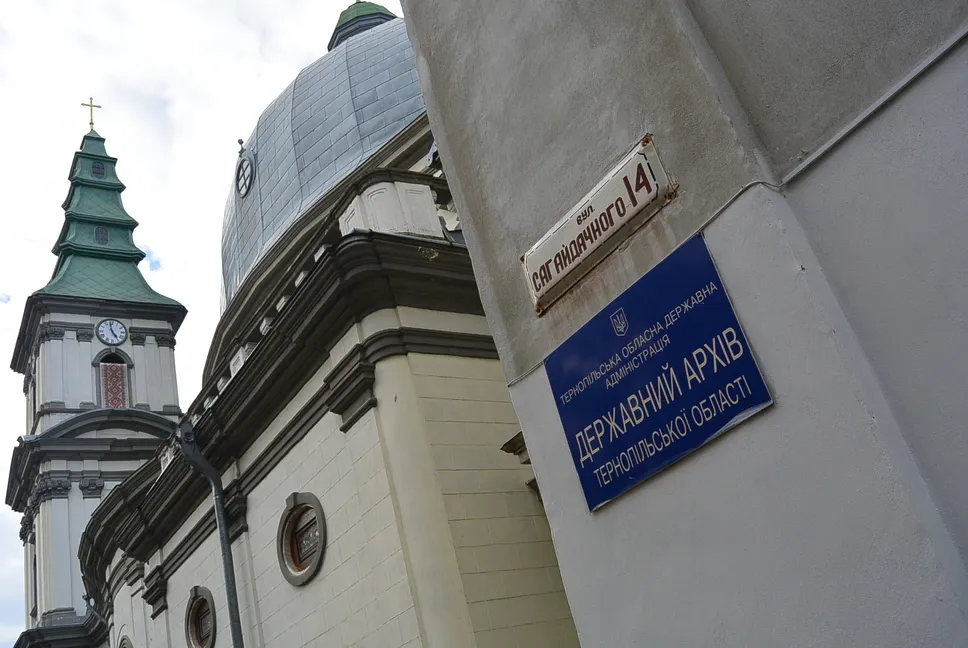
State Archives of Ternopil Region
For genealogy researchers, the archive is primarily important due to the collection of birth records stored here. The basis is birth records from settlements in the current Ternopil region for the last third of the 19th century - until the beginning of World War II. Older materials should, as a rule, be sought in Central State Historical Archive in the city of Lviv. To navigate the collection of metric books, indexes to fund No. 487 – Greek Catholic county administrations of the Ternopil region of the Galician governorate (since 1921 of the Ternopil voivodeship) and fund No. 484 – County Roman Catholic deaneries of the Galician governorate will help. These indexes can be downloaded on the archive website. You can also find the third volume of the consolidated index of metric books stored in the state archives of Ukraine on the Internet, which contains a list of metric books stored in the DATO. However, the publication has somewhat lost its relevance, since after 2010 the reorganization of the DATO metric book funds took place and the numbering of cases changed. Also, in recent years, the archive has significantly replenished with metric books transferred from the departments of the Ternopil region's registry office. It is worth noting that the process of transferring the metric and registry books that were kept before 1939 has not yet been completed, and in the registry offices of the Ternopil region, you can still find a lot of materials from the pre-war period.

The DATO contains mainly metrics from the territories of the former Austro-Hungarian Empire, as well as the second Polish-Lithuanian Commonwealth. They were kept in tabular form, which ensured their compact size compared to Russian ones. The language of the books is mainly Latin, less often Polish and Ukrainian. Since some territories of the Ternopil region were part of the Russian Empire until 1917, the metric books here are already presented according to a typically Russian model. This applies in particular to the lands of the former Kremenets district. These metric books are included in a separate fund.
Among other interesting materials of the genealogical archive are the lists of voters for the Polish Sejm, which were kept in the interwar period. They contain important information for those who are looking for materials on the map of a Pole. Other sources that can be used are materials from the police commandants of the Ternopil Voivodeship for 1921-1939 or materials from notaries. The former contain information about members of the OUN, the CPSU, and other illegal parties and organizations of the interwar period. The collections of notaries contain property agreements and various civil law documents, which can be a real find for a genealogy researcher.
To start working in the reading room, you should go through standard procedures – fill out a researcher’s questionnaire, justify why you need specific files, after which you will need to obtain permission to work in the reading room personally from the archive director. Be prepared for the administration to persistently question whether you are planning your search for commercial purposes, especially if it involves working with birth records. If the search does not concern your relatives, it is worth having a letter of authorization from the descendants of those people whose family tree you will be studying.
For out-of-towners, ordered cases can be received on the day of the order, but as a rule, materials are issued 1-2 days after the order.
Taking photographs in the archive is free, but you must first obtain permission from the archive director and write down the numbers of the sheets from which copies will be made on a separate form.